Propylene glycol (PG, CAS 57-55-6) is a colourless, practically odourless, hygroscopic liquid miscible with water, acetone, and chloroform. In pharmaceutical manufacturing, USP-grade propylene glycol is a well-established excipient — approved in oral, topical, and parenteral formulations. It also features in the Indian Pharmacopoeia (IP), British Pharmacopoeia (BP), and USP, making it one of the most universally recognised pharmaceutical excipients.
Grade Differences
| Grade | Standard | Key Specification | Typical Applications |
|---|---|---|---|
| Technical / Industrial | Manufacturer spec | ≥99.5% assay | Antifreeze, hydraulic fluids, industrial humectants |
| FCC (Food Grade) | US Food Chemicals Codex | ≥99.5%, restricted heavy metals | Food flavouring carriers, humectants in food processing |
| USP / BP (Pharma Grade) | USP / BP / IP | ≥99.5%, strict impurity profile | Pharmaceutical and cosmetic formulations |
USP and BP specifications are nearly identical. The controlled parameters are: assay by GC (≥99.5%), refractive index (1.431–1.433 at 20°C), water content (≤0.2% by KF), 1,3-propanediol content, acidity (≤0.02%), heavy metals as Pb (≤5 ppm), and chloride (≤25 ppm). Any supplier quoting "pharma grade" should be able to provide a CoA showing all these parameters for the specific batch.

Pharmaceutical Applications
Oral solutions and syrups: PG is used as a co-solvent and humectant in liquid oral formulations. It improves solubility of poorly water-soluble active ingredients and acts as a preservative at concentrations above 15%. Approved up to approximately 50% v/v in oral preparations under FDA and EMA guidelines.
Topical preparations: PG is a humectant and penetration enhancer in creams, gels, ointments, and lotions. It draws moisture and helps carry active ingredients through the skin barrier. Concentrations of 5–20% are common in dermatological products.
Injectable formulations: PG has been used as a parenteral co-solvent for poorly water-soluble drugs (notably phenytoin, lorazepam, and diazepam injections). Strict limits apply — PG accumulates in the body at high IV doses, and ICH Q3C does not classify it as a residual solvent (it is an excipient), but product-specific safety limits from clinical data govern use.
Inhalation and nasal preparations: Used as a solvent and humectant in nebuliser solutions and nasal sprays, with product-specific limits.
Cosmetic Applications
In cosmetics regulated under the Drugs and Cosmetics Act, PG functions as a humectant, solvent, viscosity-decreasing agent, and fragrance carrier. It appears in hair care, skin care, and colour cosmetic formulations. The same pharma-grade PG is typically used for cosmetics in quality-conscious manufacturers.
What to Ask For When Sourcing
- Batch-specific CoA from the original manufacturer (not the distributor's re-typed version)
- Confirm batch number on drums matches CoA — a common compliance failure point
- Country of origin and manufacturer name for your Vendor Qualification documentation
- IP/BP/USP specification stated explicitly — "pharma grade" without a pharmacopoeial reference is not sufficient for GMP procurement
Sourcing Pharma-Grade PG in South India
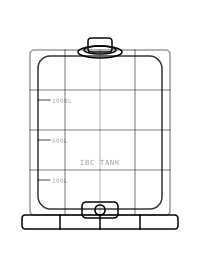
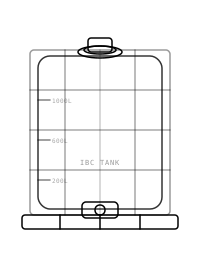
Supreme Petro Chemicals supplies propylene glycol in IP, BP, and USP grade for pharmaceutical and cosmetic manufacturers in Chennai and across South India. Available in 200-litre HDPE drums and 1,000-litre IBC tanks, with full batch documentation. Contact our team for current pricing and availability.
Grades & Packaging
Propylene glycol (CAS 57-55-6) is the same molecule across every grade — what changes is the specification it is tested against and the documentation that accompanies it. Buyers should ask for the grade name explicitly rather than the generic term "pharma grade":
- CAS Number: 57-55-6 (identical for technical, FCC, USP, BP and IP grades)
- Common commercial grade names: Technical/Industrial grade, FCC (Food Chemicals Codex) grade, and USP / BP / IP pharmacopoeial grade
- Physical form: colourless, practically odourless liquid, miscible with water
- Typical packaging: 200-litre HDPE drums and 1,000-litre IBC tanks for pharmaceutical and cosmetic manufacturers; tanker loads for larger industrial requirements
- Storage compatibility: HDPE and stainless steel containers are standard; drums should be kept sealed to limit moisture pickup, given the material's hygroscopic nature
- Documentation: pharma-grade consignments should always be accompanied by a batch-specific Certificate of Analysis that names the applicable pharmacopoeia (USP, BP or IP)
FAQ
Does the CAS number for propylene glycol change between grades?
No. CAS 57-55-6 applies to technical, FCC, USP, BP and IP grade propylene glycol alike — the substance is identical. What differs between grades is the impurity profile, the testing standard applied, and the documentation (CoA) that accompanies the batch. Always confirm the CAS number on the CoA and SDS match your purchase order.
What packaging is pharma-grade propylene glycol supplied in?
USP/BP/IP grade propylene glycol for pharmaceutical and cosmetic manufacturing is typically supplied in 200-litre HDPE drums or 1,000-litre IBC tanks, with a batch-specific Certificate of Analysis accompanying each consignment. Confirm the batch number on the drum or IBC label matches the CoA before it is taken into stores.
How do I get a quote for propylene glycol from SPC?
Share your required grade (USP/BP/IP or technical), monthly quantity, preferred packaging, and delivery location via the contact page. Quotes are typically answered within 4 working hours, Monday to Saturday.