What a CAS number is, and what this page lists
A CAS Registry Number is a unique numeric identifier assigned by CAS, a division of the American Chemical Society, to one specific substance. It is the one field on a purchase order that a trade-name synonym cannot blur. This page lists verified CAS numbers for 20 chemicals we supply, each with its molecular formula, the grades we hold and the packaging those grades move in. A CAS number alone does not specify grade, assay or standard.
This is the identifier reference. For the procurement process built around those identifiers — purchase-order templates, cross-referencing quotes between suppliers, substitution risk — read our procurement-process guide to CAS numbers.
How is a CAS number structured, and what does the check digit prove?
A CAS number is written in three hyphen-separated segments: a first segment of up to seven digits, a second segment of two digits, and a single check digit. The check digit proves only that the number is internally consistent — that it was transcribed without a typo. It proves nothing about the substance itself.
The check digit is calculated by reading every digit before the final hyphen from right to left, multiplying each by its position (1, 2, 3, and so on), summing the products, and taking the remainder on division by 10.
Worked example on methylene dichloride, CAS 75-09-2. The digits before the check digit are 7, 5, 0, 9. Reading right to left:
- 9 × 1 = 9
- 0 × 2 = 0
- 5 × 3 = 15
- 7 × 4 = 28
The sum is 52. The remainder on division by 10 is 2, which matches the published check digit. The number is valid. Run the same arithmetic on any CAS number typed into a Certificate of Analysis or a purchase order and a transposition error surfaces immediately. Every number in the table below has been validated this way before publication.
CAS number reference table — 20 chemicals we supply
Each row is a self-contained identity record: trade name, full chemical name, CAS number, molecular formula, the grades we hold, and the packaging forms those grades move in. Grades, assay figures and pack sizes follow the specification recorded on each linked product page, taken from the manufacturer's technical data sheet or Certificate of Analysis for the grade named; where the grade is a specific manufacturer product, that product is named in the row. Every consignment ships against a batch-specific Certificate of Analysis, and that is the figure that governs.
| Trade name | Full chemical name | CAS number | Formula | Grades supplied | Packaging forms |
|---|---|---|---|---|---|
| Methylene Di Chloride (MDC) | Dichloromethane | 75-09-2 | CH₂Cl₂ | Industrial, technical, pharma; 99.9% min by GC | 250 kg MS barrel, 1000 L IBC, bulk ISO tanker |
| Hydrochloric Acid (HCl) | Hydrogen chloride, aqueous solution | 7647-01-0 | HCl in water | Commercial 30%, technical 33%, synthetic 35% | 35 kg HDPE carboy, 200 L HDPE barrel, 1000 L HDPE IBC, bulk rubber-lined tanker |
| Nitric Acid | Nitric acid | 7697-37-2 | HNO₃ | Commercial grade, 60–70% as HNO₃ | Carboys, road tanker |
| Liquor Ammonia | Ammonium hydroxide (aqueous ammonia) | 1336-21-6 | NH₄OH | Super Strong Grade | Carboys |
| Chromic Acid | Chromium trioxide (chromic anhydride) | 1333-82-0 | CrO₃ | Technical, industrial; 99.0% min CrO₃, flake | 25 kg double-lined HDPE bags, 50 kg HDPE bags |
| Butyl Cellosolve | Ethylene glycol monobutyl ether (2-butoxyethanol) | 111-76-2 | C₆H₁₄O₂ | Solvent grade, 99.0% wt min | MS drums |
| Butyl Carbitol | Diethylene glycol monobutyl ether (butyl diglycol ether) | 112-34-5 | C₈H₁₈O₃ | Butyl diglycol ether, 99.0% wt min | Drums, IBC |
| MEK | Methyl ethyl ketone (butan-2-one) | 78-93-3 | C₄H₈O | Industrial, technical; 99.5% min by GC | 200 L MS barrel, 1000 L IBC |
| Mixed Xylene | Xylene, isomer mixture with ethylbenzene | 1330-20-7 | C₈H₁₀ | Industrial, technical; 98.5% min xylene isomers plus ethylbenzene | 200 L MS barrel, 1000 L IBC, bulk tanker |
| N-Propanol | Propan-1-ol (n-propyl alcohol) | 71-23-8 | C₃H₈O | Industrial, 99.80% min | MS drums |
| DEG | Diethylene glycol (2,2'-oxydiethanol) | 111-46-6 | C₄H₁₀O₃ | Industrial grade, 99.80% wt min | 230 kg drums, bulk tanker |
| LAB | Benzene, mono-C10-13-alkyl derivatives | 67774-74-7 | C₆H₅–CₙH₂ₙ₊₁ (n = 10–13) | Detergent alkylate C10–C13; 98.0% min LAB content by mass | Bulk road tanker, drums |
| CAPB | Cocamidopropyl betaine | 61789-40-0 | Mixture — no single formula | Ginamide B (Godrej Industries); active betaine 29.0% min | 50 kg HMHDPE carboys |
| Titanium Dioxide | Titanium dioxide | 13463-67-7 (rutile 1317-80-2, anatase 1317-70-0) | TiO₂ | Rutile — KEMOX RC-822 (KMML); TiO₂ 93.0% min, rutile content 99.0% min | 25 kg bags |
| Urea | Carbamide | 57-13-6 | CH₄N₂O | Technical / industrial prilled; total nitrogen 46.0% w/w min (dry basis), biuret 1.0% w/w max | 50 kg woven sack, 25 kg HDPE bag, 1000 kg jumbo bag |
| Acetic Acid | Acetic acid, glacial | 64-19-7 | C₂H₄O₂ | Industrial, technical, food; glacial 99.8% min | 200 L HDPE barrel, 35 L HDPE carboy, 1000 L IBC, bulk tanker |
| IPA | Propan-2-ol (isopropyl alcohol) | 67-63-0 | C₃H₈O | Industrial, technical, pharma (IP/BP/USP), electronic; 99.7% min by GC | 200 L MS barrel, 1000 L IBC, bulk tanker |
| Toluene | Methylbenzene | 108-88-3 | C₇H₈ | Industrial, technical, nitration grade; 99.5% min by GC | 200 L MS barrel, 1000 L IBC, bulk tanker |
| Propylene Glycol | Propane-1,2-diol | 57-55-6 | C₃H₈O₂ | Pharmacopoeial (IP / USP / BP / EP); not less than 99.5% w/v by GLC | HDPE or MS drums, 215 kg net |
| Ethyl Acetate | Ethyl ethanoate | 141-78-6 | C₄H₈O₂ | Commercial / industrial grade, 99.80% min | Bulk tankers, dedicated cleaned, approximately 20 MT loads |
Why does the same chemical have several CAS numbers?
Because a CAS number identifies a substance, not a commercial name. Where a trade name covers a mixture, an isomer family, or more than one chemical form, several valid CAS numbers exist and only one of them describes what will physically arrive. Three cases in the table above show the pattern.
Mixed xylene. CAS 1330-20-7 is the registry number for the commercial isomer mixture — ortho, meta and para xylene together with ethylbenzene. Each separated isomer has its own number: ortho-xylene 95-47-6, meta-xylene 108-38-3, para-xylene 106-42-3, and ethylbenzene 100-41-4. The number 95-47-6 denotes a distillation-separated single isomer, a different substance from the blend, made by a different process and priced differently. The blend used as a general-purpose paint and ink solvent is 1330-20-7.
Chromic acid. The material traded in India as chromic acid is chromium trioxide, CrO₃, CAS 1333-82-0 — a dark red crystalline flake that the buyer dissolves in water on site. The true aqueous acid H₂CrO₄ carries CAS 7738-94-5. Many listings quote the aqueous number for flake material. The two numbers describe different physical forms: a solid oxidiser versus a solution, with different handling, storage and packaging consequences.
Titanium dioxide. The generic substance is 13463-67-7, but the two commercial crystal forms carry their own registry numbers — rutile 1317-80-2 and anatase 1317-70-0. They are not interchangeable: rutile is the durable, higher-opacity form used in exterior paints and masterbatch, anatase the softer form used where photocatalytic activity or a bluer tone is wanted. Quoting only 13463-67-7 leaves the crystal form open, so state rutile or anatase alongside the number.
The same discipline applies to ammonia. What ships as liquor ammonia is aqueous ammonium hydroxide, CAS 1336-21-6, a solution in carboys. Anhydrous ammonia is CAS 7664-41-7, a liquefied gas under pressure with a different UN number, different containment and a different hazard profile. They are not the same purchase.
What a CAS number does not tell you
A CAS number identifies the substance and nothing else. It carries no assay, no grade, no pharmacopoeial reference, no isomer ratio, no stabiliser package, and no packaging. Propylene glycol is 57-55-6 whether it is technical grade or IP/BP/USP grade. Toluene is 108-88-3 whether it is solvent grade or nitration grade. Specify CAS plus grade plus standard, or the specification is incomplete. Our companion guide to IP, BP and USP pharmacopoeial grades covers the grade half of that pair.
CAS, EC, UN and HSN — four identifiers, four different jobs
Four numbering systems appear on chemical paperwork and none substitutes for another. CAS identifies the substance, EC identifies its European regulatory listing, UN identifies its transport hazard classification, and HSN identifies its customs and GST tariff treatment. A shipment can be fully compliant on one and wrong on another.
| Identifier | Issued by | What it identifies | Where it appears |
|---|---|---|---|
| CAS Registry Number | CAS, a division of the American Chemical Society | One specific substance, permanently and uniquely | CoA header, SDS section 3, purchase order, drum label |
| EC / EINECS number (seven digits, format XXX-XXX-X) | European Commission | The substance's entry on the European inventory of existing commercial substances | SDS section 3, alongside the CAS number |
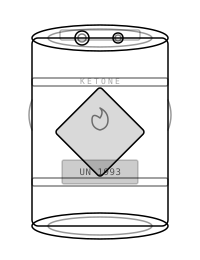
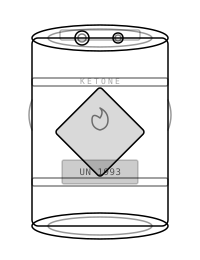
| UN number (four digits) | UN Committee of Experts on the Transport of Dangerous Goods | The transport hazard classification of the substance or mixture | SDS section 14, transport documents, package hazard label |
| HSN code | Indian customs and GST authorities, derived from the WCO Harmonised System | The tariff and tax classification of the traded goods | Customs bill of entry, commercial invoice, GST invoice line |
One CAS number can sit under several HSN lines depending on grade and end use, and one HSN line can cover many CAS numbers. UN numbers are coarser still: hydrochloric acid solution ships under UN 1789 and dichloromethane under UN 1593, but the packing group and concentration limits must be read off the current SDS section 14 rather than assumed. With direct import capability we quote all four on shipping documentation, because a mismatch between the invoice HSN line and the SDS is a customs query waiting to happen.
How to verify a CAS number on an incoming consignment
Verification catches relabelled or misdespatched material before it enters a process. Do this at the gate, before decanting, while the consignment can still be rejected intact.
- Read the CAS number printed on the drum, carboy or bag label.
- Match that number against SDS section 3 for the same product and batch.
- Match it against the Certificate of Analysis header and the grade named there.
- Match it against the CAS number on the purchase order and the HSN line on the invoice.
- Run the check-digit calculation described above on the printed number.
- Confirm the grade, assay and standard separately, since the CAS number does not carry them.
- Flag any mismatch and hold the consignment before decanting or issuing to production.
FAQ
What is the CAS number of MDC?
Methylene dichloride, also traded as dichloromethane or DCM, has CAS Registry Number 75-09-2. Its molecular formula is CH₂Cl₂. The number identifies the substance only — it carries no assay, no grade and no stabiliser information, so state those separately on the purchase order.
What is the CAS number of HCl?
Hydrochloric acid has CAS Registry Number 7647-01-0, which is the registry number for hydrogen chloride and is used for its aqueous solutions in commercial documentation. The number does not encode concentration. Commercial 30%, technical 33% and synthetic 35% solutions all carry 7647-01-0, so specify the percentage separately.
What is the CAS number of nitric acid?
Nitric acid has CAS Registry Number 7697-37-2 and molecular formula HNO₃. Concentration is not encoded in the number. We supply commercial grade at 60–70% as HNO₃, and that strength must still be stated on the purchase order and confirmed on the Certificate of Analysis.
Is 1330-20-7 the same as xylene?
CAS 1330-20-7 is mixed xylene — the commercial blend of ortho, meta and para isomers with ethylbenzene. The separated isomers have their own numbers: ortho-xylene 95-47-6, meta-xylene 108-38-3, para-xylene 106-42-3. Quoting an isomer number when the blend is wanted changes what is despatched, and the price with it.
Does a CAS number guarantee purity?
No. A CAS number identifies which substance is in the drum, not how much of it. Assay, impurity limits, water content, colour and stabiliser package are set by the grade and the applicable standard, and are evidenced on the batch Certificate of Analysis. Always specify CAS number and grade together.
Raise an enquiry with the identifier and the grade together
Quote three things and a quotation can be prepared without a follow-up call: the CAS number, the grade or standard you need, and the pack size. Add the delivery location if it is outside Tamil Nadu. Reach Sanketh on +91 86087 80096 by WhatsApp, write to admin@supremepetrochemicals.com, or use the contact page. Every consignment we despatch from Redhills, Chennai carries the manufacturer's batch Certificate of Analysis with the CAS number and grade stated on it.